This blog is taken from my Seven Feasts of the Lord sermon notes file. I have uploaded it to my blog so that my readers can have a brief, but simple glimpse of what the Feast of Trumpets is all about. – Pastor Rob Lee
The Feast of Trumpets (aka Rosh Hashanah) is the first of the three Fall feasts of the Lord. It is observed over a two-day period or as one long day as some Jews say.
“Then the Lord spoke to Moses, saying, “Speak to the children of Israel, saying: “In the seventh month, on the first day of the month, you shall have a Sabbath rest, a memorial of blowing of trumpets, a holy convocation. You shall do no customary work on it; and you shall offer an offering made by fire to the Lord.” – Leviticus 23:23-25
While there are different dates from different calendars that identify when this feast actually occurs, it is always celebrated in the Fall. Depending on which calendar you use. This year, Rosh Hashanah lands on (Gregorian calendar) 9/23-24/25.
- The Feast of Trumpets – aka Rosh Hashanah (Hebrew: ‘head of the year.’)
- This Rosh Hashanah the Hebrew year changes from 5785 to 5786.
The traditional teaching of the Torah states that the creation account took place exactly 5,785 years ago; the beginning of time and human history as we know it.
In the west, we divide history into two camps, BC (Before Christ) and AD Anno Domini which means ‘in the year of our Lord (Jesus). AD refers to events that occurred after Christ’ death and resurrection. Now it’s BCE (before common era) and CE (common era) to erase Jesus from the OT and NT time continuum. However, believers know who really split the timeline in half; it was Jesus.
Since the Jewish rabbinical tradition doesn’t recognize Christ, they follow the Hebrew calendar which records its dates as AM – Anno Mundi meaning ‘The Year of the World.’ This perspective is reflected in how the Hebrews record time.
For example, in Genesis we read, “And the Lord said, “My Spirit shall not strive (abide) with man forever, for he is indeed flesh; yet his days shall be one hundred and twenty years.”
– Genesis 6:3
- The rabbinical teaching states that these 120 years are Jubilee years; 50-year increments that extend out to 6,000 years (120 x 50 = 6,000).
NOTE: The exact Jubilee date has previously been claimed by others; but to accurately determine when a Jubilee begins or ends, is an ‘inexact science.’
Hebrew tradition states that… on Rosh Hashanah
…Adam and Eve were created, on the sixth day of the creation account.
…Noah removed the hatch cover on the ark and dispatched the dove.
…Pharaoh’s cup bearer and baker had dreams related to their judgments.
…Joseph was released from his Egyptian prison.
…Pharaoh freed the Israelites from their Egyptian slavery.
…Moses received the Law from God atop Mount Sinai.
…The Bema Seat and Great White Throne Judgments occur (separately).
…Ezra began to read the law to the people in 444 BC. Nehemiah 8:2.
…The Rapture/Resurrection occurs.
…The ‘Day of the Lord’ begins.
…The revelation of Jesus was given to John on the Isle of Patmos.
While these dates may be debated among Christian scholars, the Jews have a specific viewpoint of Rosh Hashanah as it coincides with certain OT events. To fully understand and appreciate the Feast of Trumpets, we must first understand what all of the seven Feasts of Israel actually represent.
The Hebrew word for ‘feast’ is mo’ed, meaning, ‘a set or appointed time.’
A similar Hebrew word is mikrah, meaning, ‘a rehearsal or recital.’
When we celebrate a certain feast, we are either commemorating an event in history (the Spring Feasts) or anticipating a future event in prophecy (the Fall Feasts).
Each of the seven feasts of the Lord offers a significant portrait of both what has happened in biblical history, as well, a prototype and foreshadowing of future things which will happen at their appointed time as part of God’s prophetic plan.
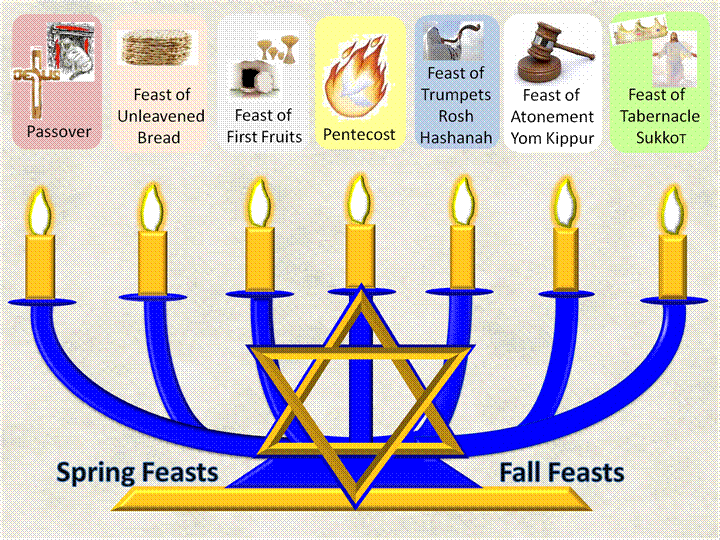
POINT: God wants His people to know what He is doing right now, what He has done in the past, and what He is going to do in the future.
- God has given us a blueprint of His great prophetic plan for us in His Word. An outline of His revelation is contained within the structure of the seven feasts of the Lord.
Genesis 18:17 – “Shall I hide from Abraham what I am doing…”
Amos 3:7 – “Surely the Lord God does nothing, unless He reveals His secret to His servants the prophets.”
The three (3) Fall Festivals occur during the latter rains of Israel, in the Fall.
They occur in this order of their celebration:
The Feast of…
- Feast of Trumpets (Rosh Hashanah) – Jewish New Year (Rapture).
- Feast of Atonement (Yom Kippur) – Day of Atonement (Trib & 2nd Coming).
- Feast of Tabernacles – The winter season recycles (Millennial Reign).
Hosea 6:3 – “He (Messiah) will come to us like the rain, like the latter and former rain to the earth.”
- The prophet Hosea was communicating with prophetic utterance that the Messiah would come to the earth twice, once in the former rain (as a babe in a manger and suffering servant of God), and once in the latter rain (as King).
The first four feasts represent the former rain and what we have already seen in biblical history; this speaks to Christ’ first coming to the earth.
The last three feasts represent the latter rain and what we are yet to see in biblical prophecy, as Jesus will return to the earth again, but this time, to stay.
NOTE: Jesus ascended into heaven in bodily from the Mount of Olives during the Feast of Firstfruits. Exactly 10 days later after Jesus ascended into heaven, (which was 50 days after His resurrection); during the Feast of Pentecost, the Holy Spirit descended and empowered the disciples in the upper room.
- The last of the former rain feasts was the Feast of Pentecost. This has already occurred historically and prophetically in Acts 2 when the Holy Spirit descended upon the 120 believers who were gathered in the upper room.
POINT: God does everything with prophetic significance and His timing is precise.
- We are currently living in the period of time between the former and latter rain. This time period is the age or dispensation of grace; the NT era.
For the past 2000 years we have been living under the New Covenant of Christ’s blood. The Feast of Trumpets is the next feast on God’s prophetic calendar.
We believe that the prophetic significance of this feast is quickly approaching – the Rapture of the Church.
- The Feast of Pentecost – a type and shadow of a betrothal.
“For I am jealous for you with godly jealousy. For I have betrothed you to one husband, that I may present you as a chaste virgin to Christ.” – 1 Corinthians 11:2
- The Feast of Trumpets – a type and shadow of a wedding.
Credit: Pastor John Hagee ‘The Prophecy of Trumpets’ from His Glory Revealed
This Feast of Trumpets occurs over a two-day period, beginning on the first day at dusk and continuing until dusk the following day. This year, according to the Gregorian calendar, this feast occurs tonight at dusk.
THE JEWISH CALENDAR:
It operates in two cycles; one is on a religious cycle and the other is on a civil cycle. The religious calendar begins in the spring while the civil calendar begins in the fall, on the seventh month, the month of Tishri (September/October).
- This feast also symbolizes the re-gathering of Israel, something that has been taking place since May 14th, 1948 when Israel became a sovereign nation.
In 70 AD the temple was destroyed by the Romans and the Jewish Diaspora began; from then until May 14th, 1948 the Jewish people had been without a homeland. Now, they’re returning by the thousands each year as part of God’s prophetic plan.
Jeremiah prophesied this event, “Thus says the LORD: “Against all My evil neighbors who touch the inheritance which I have caused My people Israel to inherit—behold, I will pluck them out of their land and pluck out the house of Judah from among them. 15 Then it shall be, after I have plucked them out, that I will return and have compassion on them and bring them back, everyone to his heritage and everyone to his land.” – Jeremiah 12:14,15
- We are now living in the long interval between the Feast of Pentecost and the Feast of Trumpets; the NT era. The next prophetic event on God’s calendar is the re-gathering of Israel, which is a type and shadow of the Rapture. Once the Church is removed, then the Lord will focus on the nation of Israel.
The Feast of Trumpets is an OT prototype of the NT Rapture of the Church.
It is a feast to be cherished and celebrated as Jesus Christ, our blessed hope, is coming back, in the air, for His church.
“looking for the blessed hope and glorious appearing of our great God and Savior Jesus Christ,” – Titus 2:13
- I believe that the Apostle Paul, through the prophetic lens of scripture, was speaking of two advents here:
1. The ‘blessed hope’ is the Rapture/Resurrection.
2. The ‘glorious appearing’ is the Second Coming of Jesus.
A traditional Feast of Trumpets celebration would begin with the assembling of the priests at the temple or synagogue. They would adorn themselves in priestly robes and blow shofars in rhythmic succession to call sinners to repentance, to confuse the enemy, and to herald in the new year.
Shofars have always held a prominent role in biblical history.
The shofars were sounded…
…when the Torah was given to Israel. – Exodus 19:19
…when the walls of Jericho fell. – Joshua 6:20
…to frighten the Midianites who opposed Gideon’s army. – Judges 7:16-20
…at the beginning of the year of Jubilee. – Leviticus 25:9
…to announce the beginning of all the Jewish festivals. – Numbers 10:10
…during the coronation of new kings. – 1 Kings 1:34,39
We know that seven shofars will be sounded as God judges the earth during the tribulation period (Revelation 8 & 9 – aka the Trumpet Judgements).
When Jesus comes for His Church in the Rapture we who are caught up will hear the trumpet blast of God.
“For the Lord Himself will descend from heaven with a shout, with the voice of an archangel, and with the trumpet of God. And the dead in Christ will rise first. 17 Then we who are alive and remain shall be caught up together with them in the clouds to meet the Lord in the air.” – 1 Thessalonians 4:16,17
The Apostle Paul also mentions ‘the last trump.’
“Behold, I tell you a mystery (hidden truth): We shall not all sleep, but we shall all be changed— 52 in a moment, in the twinkling of an eye, at the last trumpet. For the trumpet will sound, and the dead will be raised incorruptible, and we shall be changed.”
– 1 Corinthians 15:51,52
- Hebrew tradition tells us that the Feast of Trumpets contained the ‘last trump.’ and Yom Kippur (The Day of Atonement) sounded the ‘great trump.’
On the Feast of Trumpets, traditionally 100 blasts of the shofar would be sounded, with the last being the Tekiah Hage-dolah – a specific long blast. Despite the lack of scriptural corroboration for these blasts, the Jewish traditions seem very compelling. As such, this feast has remained a ‘high watch’ day for me as a possible shadow fulfillment of the Rapture.
As we observe the order we see that when the first trump sounds, the dead in Christ shall rise first. When the last trump sounds, we who are alive and remain will be caught up with them in the air.
NOTE: There are two trumpets for the Rapture; two trumpet blasts: a first one and a last one. The first, for the dead in Christ; the last, for we who are alive and remain.
When Jesus physically returns to the earth in His Glorious Second Coming, there will also be a loud trumpet blown to announce it.
“Then the Lord will be seen over them (the nations of the earth), and His arrow will go forth like lightning. The Lord God will BLOW THE TRUMPET, and go with whirlwinds from the south…” – Zechariah 9:14
David the psalmist wrote, “With TRUMPETS and the sound of a horn; shout joyfully before the Lord, the King.” – Psalm 98:6
“Blessed are the people who know ‘the joyful sound’ (referring to a trumpet/shophar).” – Psalm 89:15
The trumpets of God are the most important signal the world can possibly receive. It’s no wonder that the Rapture begins with the blowing of a mighty trumpet. Rosh Hashanah aka ‘Yom Teruah’ means ‘the day of the awakening blast.’
A paramount theme for Jewish people during Rosh Hashanah is self-examination and repentance. Repentance begins with the recognition of one’s faults, failures, and weaknesses along with the expression of their willingness to change.
Broken relationships are mended, forgiveness is sought out from those we have offended, and all for the purpose of entering the new year with a ‘clean slate.’
The Feast of Trumpets falls near the end of a special 40-day Jewish season called Yom-Teshuvah – (Hebrew: ‘return or repent’). Teshuvah begins on the first day of Elul (around the middle to late August) and ends on Yom Kippur, the Day of Atonement – which takes place 10 days after the Feast of Trumpets.
- The message for the Jewish people is clear, repent before the Feast of Trumpets; don’t wait until that day to make it right with others and with God.
- The message for the Church is also clear, repent before the Rapture of the Church; don’t wait until that day to make it right with others and with God.
The 10 days following the Feast of Trumpets that lead up to Yom Kippur are called the Days of Awe. This is a time of serious reflection of one’s personal faith in God. It is a time to reverence the Lord and His will for one’s life.
Five days after Yom Kippur is the final Fall feast, The Feast of Sukkot.
- The Feast of Trumpets is a type and shadow of the Rapture of the Church.
Trumpets occurs before Atonement which infers a pre-tribulation event.
- The Feast of Trumpets celebrates the blessed hope of Jesus Christ.
Our blessed hope is that we will live again with Jesus and those who love Him.
- The Feast of Trumpets is something you need to be ready for.
Being ready is akin to getting ready and staying ready – are you ready?
Final Thoughts about the Feast of Trumpets:
It’s also known as ‘the feast that nobody knows the day or hour.’ This title is derived from a Jewish idiom pertaining to a Jewish marriage. It’s also ascribed to this feast as it occurs over two days and 24 hours. The new moon had to be sited and reported to the priest by at least two witnesses before the feast could begin.
In the same way that no one knows the day or the hour of the Feast of Trumpets, no one knows the day or hour of the Lord’s return. In this way the Feast of Trumpets is connected to the Rapture of the Church.
Maranatha!
Encouragemen is a blog written by Pastor Rob Lee, who resides in Northern Missouri. He lives with his wife of 37-years, near their three adult children, their spouses, and children (their grandchildren). Pastor Rob is an Ordained Assemblies of God minister, a Lead Pastor (30+ years), police chaplain, and community advocate. He continues to serve, consult, and disciple men of God, including those who are in the ministry.
 Encourage Men
good word Brother 🙏🏻❤️
LikeLike